
Microsoft has published a new performance benchmark exploring how different Power BI architecture and storage-mode choices perform when reporting on data stored in Azure Databricks.
The analysis compares multiple approaches to serving the same Delta tables, giving Power BI developers and data teams a clearer view of the performance trade-offs involved. In this article, we take a closer look at what was tested and what the results could mean for your reporting architecture.
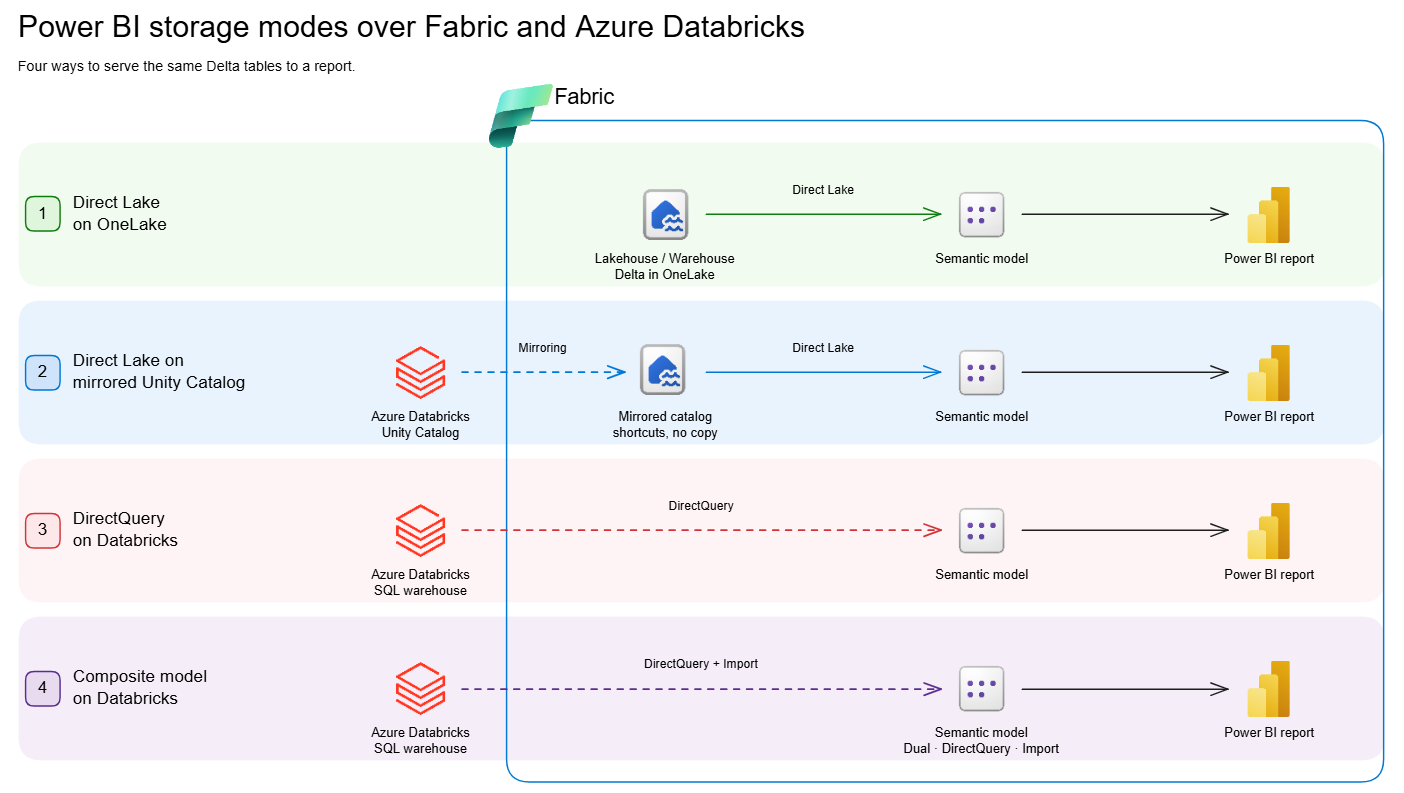
What’s Being Compared?
Microsoft’s latest white paper compares four different approaches for serving the same Delta tables to Power BI reports when Azure Databricks is the data source. It looks at Direct Lake on OneLake, Direct Lake on mirrored Unity Catalog tables, DirectQuery on a Databricks SQL warehouse, and Composite Models with import-mode aggregations.
What Do the Results Show?
There’s no universal winner, but clear performance patterns emerge across the different scenarios. Direct Lake on OneLake performed well across the broadest range of situations, particularly for smaller and mid-sized volumes and frequently accessed Power BI reports.
The Fastest Pattern at Scale
When working with billions of rows, Composite Models with aggregations delivered the fastest and most consistent results in the benchmark. Queries resolved by the aggregation tables stayed below 100ms, although queries that fall through to the underlying DirectQuery source can lose that advantage.
What Should You Take Away?
Performance varies depending on data volume, cache state, filtering scenarios and query type, so the headline results don't tell the whole story. The white paper provides the detailed benchmark results and testing methodology to help you assess which approach makes sense for your environment.
One Important Consideration
The comparison reflects a point-in-time benchmark from June/July 2026, and both Power BI and Azure Databricks continue to evolve. Use the findings as a guide, then validate the results against your own data, workloads and user behaviour.
Read the full white paper to explore the benchmark results, test setup and performance breakdowns in detail.
Discover how Business Intelligence can turn your data into better insights and smarter decisions. Contact us today to explore what’s possible for your organisation.