
Microsoft has announced the general availability of DAX User-Defined Functions (UDFs) in Power BI, marking a major milestone for semantic model development. The feature enables developers to create reusable DAX logic that can be shared across measures, columns, and calculations, helping reduce duplication and improve model maintainability. With UDFs now production-ready, organisations can build more scalable and consistent Power BI solutions while simplifying ongoing development and governance.
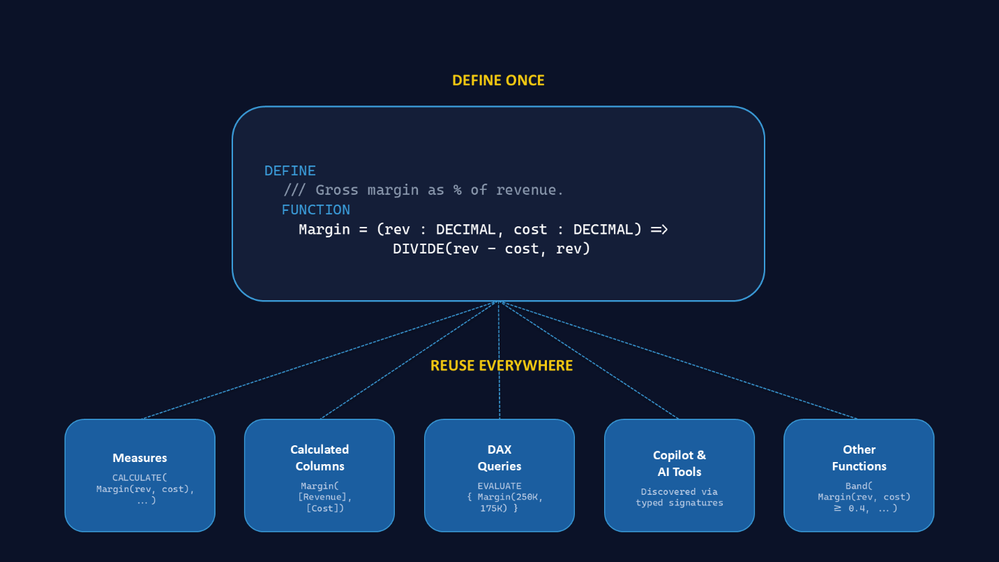
Here's what you need to know:
Reusable, discoverable DAX building blocks
Write a calculation once and reuse it across measures, calculated columns, and visuals. UDFs help reduce duplicated logic, improve maintainability, and support more consistent reporting. With documentation comments, typed parameters, and IntelliSense support, functions become easier to understand, test, and share across teams.
AI-ready business logic
Because DAX UDFs are first-class model objects with typed signatures and descriptions, tools like Copilot can discover and invoke them more effectively. This provides AI with a trusted, well-defined API into your business logic rather than relying on inferred DAX expressions.
Simple function creation and reuse
Functions can be defined once and called throughout your model. UDFs can even call other UDFs, allowing you to create modular, layered calculations that are easier to maintain and scale.
Enterprise governance and collaboration
Store UDFs as TMDL files and manage them through Git repositories. Teams can build shared libraries of approved business logic, enforce standards, track versions, and reduce logic drift across semantic models.
New GA capabilities
General availability introduces web modeling support, optional parameters, enhanced type hints for greater flexibility and runtime safety, and the ability to create and edit UDFs directly in Model View within Power BI Desktop.
Discover how Sport Wellington leveraged Power BI to transform participant data into meaningful insights and demonstrate improvements in health literacy. Read the case study and contact us to learn how Power BI can help your organisation make more informed, data-driven decisions.